Don't Overshoot Your Seed, Fundraising Advice from DDS Founders Fund
By DDS Matchmaker Editorial · · Updated
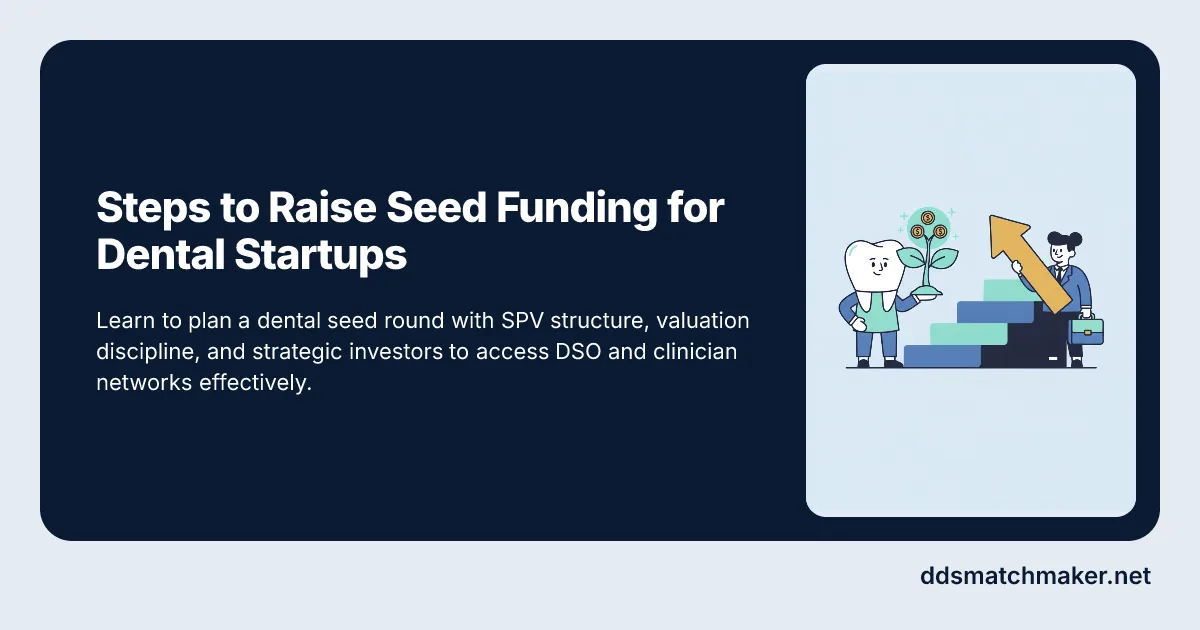
Summary: To raise seed funding for a dental startup, focus on aligning with dental investors and creating a clean cap table using a Special Purpose Vehicle (SPV). Prioritize strategic investors who can aid in adoption and distribution, and ensure your valuation is supported by a realistic forecast. Avoid chasing high valuations and instead facilitate easy investment from industry insiders to maintain a manageable investor list.
A dentist loves the demo, asks whether the round is open, and the talk shifts into cap-table trouble before the deck is even done. For a dental startup raising seed money, the round should be built around aligned dental investors, a clean SPV, and a forecast that supports the price you are asking for. The pitch matters. The structure decides whether small strategic checks turn into useful capital or become admin drag. The best seed plan for dental founders is not a hunt for the highest headline valuation. The better move is to make investment simple for dentists, DSOs, specialists, advisors, and industry operators, while avoiding a tangled investor list later.
Darius Somekhian of DDS Founders Fund puts the fundraising problem in plain terms: a dental founder should treat round design as seriously as the story. Dentistry runs on relationships, and seed capital works better when the people writing checks can also help with adoption, pilots, clinical credibility, or distribution.
Start with the SPV before chasing small checks
A Special Purpose Vehicle solves the cap-table problem that dental founders create when they let many operators invest directly. An SPV bundles those smaller investors into one line on the cap table, which keeps the round cleaner for future institutional investors and makes life after closing less painful. DDS Founders Fund uses Sydecar because Darius Somekhian likes a simple interface, responsive support, and a one-time setup cost that varies with raise size. The software vendor is not the main point. The main point is that the entity, signatures, wires, and investor reporting should not sit on the founder while the company is still trying to prove sales.
A low minimum check is part of the strategy in dentistry. Darius recommends starting with a smaller investment because many dentists are more willing to back a strategic round at that level, while larger amounts can call for more personal financial thought.
An SPV costs money and needs someone accountable behind it, so a founder with one or two serious lead investors should not add extra structure just to look polished. The SPV earns its place when the round depends on a group of smaller dental insiders whose names matter more than the size of any single check.
Pick investors who know dental buyers
Dental money is not the same as generic healthcare money when the product has to win trust inside practices, DSOs, specialist groups, or labs. A healthcare startup gets little from a real-estate SPV if the investors cannot introduce early customers, explain procurement, or test whether dentists will change workflow for the product. Capital has moved toward oral health, but that does not mean every dollar is equally useful. DentistryIQ reported in 2024 that oral-health VC funding reached 59 deals totaling $400.2 million through much of the year, while PitchBook reported that VCs spent $326 million across 38 dental deals in a peak year for dental technology investment.
Industry-specific funds also signal that oral health has become a defined investment category, not a side interest inside broader healthcare. BusinessWire reported in 2022 that Revere Partners launched the first dedicated oral-health venture fund, which helps explain why dental founders now need a sharper answer on strategic fit rather than a generic seed narrative.
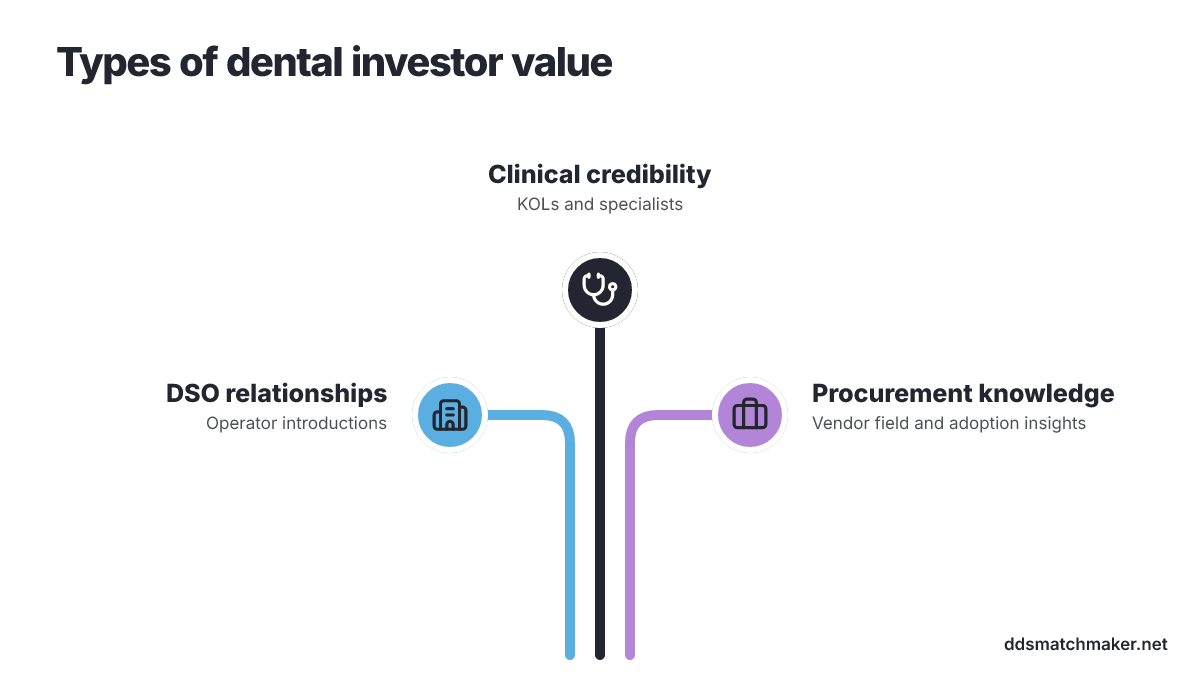
Dental founders should map investors by what they can do after the wire clears. A founder building clinical credibility may need KOLs and specialists. A DSO-facing workflow product may need operator introductions. A company that depends on procurement should know the vendor field before promising fast adoption, which is where resources such as the DDS Vendors dental network belong in early market thinking.
Keep the valuation below the story you can prove
A seed valuation that runs ahead of the evidence turns the next round into a fight with your own numbers. Darius Somekhian prefers smaller seed rounds, so the company has room to grow, can earn investor trust, and keeps space for later financing.
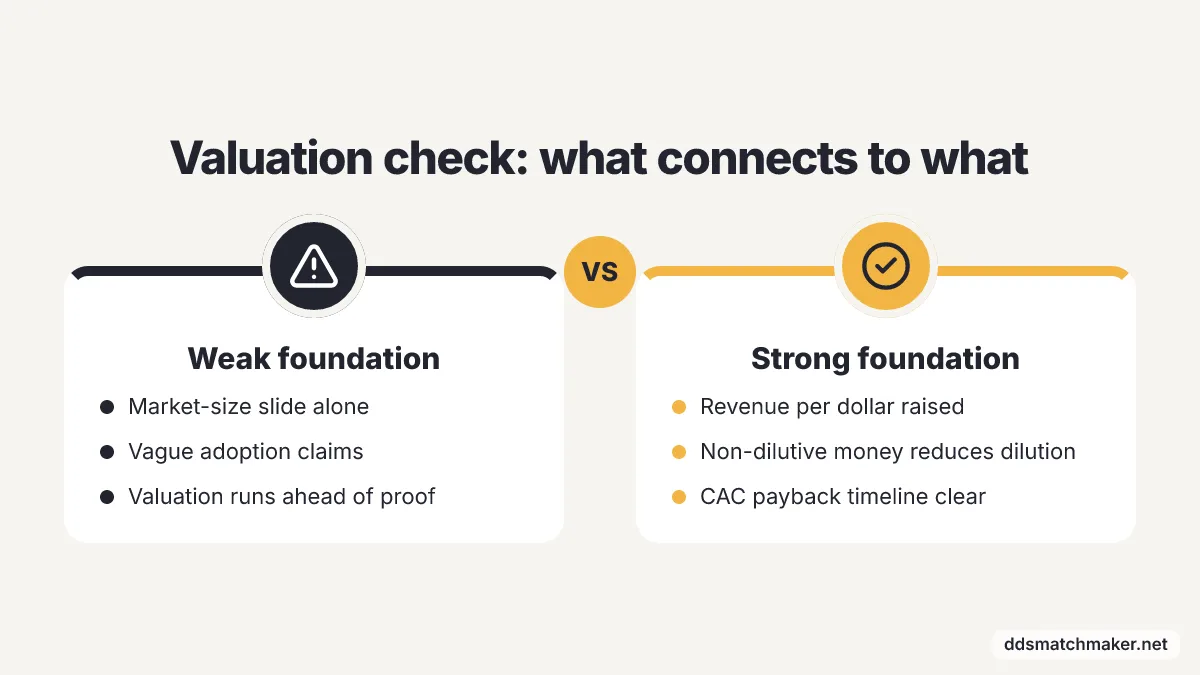
If a founder raises at a $20M valuation, they should be able to explain how the business reaches something near $60M within a believable window. A market-size slide does not do that work. The forecast has to connect product milestones, revenue growth, customer acquisition, hiring, and capital needs in a way an investor can check. DDS Founders Fund looks at dental startups through three operating questions, how much revenue comes in for each dollar raised, whether grants or other non-dilutive money cut dilution, and how fast customer acquisition cost gets paid back. A company that took grants before commercialization carries a different risk profile from one asking equity investors to fund every experiment.
Clean financials matter because dental investors may know the market, but they still need to see burn, runway, contracted revenue, pilot commitments, and the assumptions behind the forecast. A pre-revenue company can get funded when it has a clear moat or a strong market position, but vague adoption claims will not support a premium valuation.
What should happen before the first investor call?
A founder should set up the round like an operating plan before asking for meetings. The investor call comes late in the process, not at the start.
- Write the use of funds in plain operating terms, such as product build, regulatory work, sales hires, pilot support, or clinical validation.
- Decide whether the round needs an SPV because many strategic checks are expected.
- Set a minimum check that dentists and operators can approve quickly without slowing the raise.
- Build a forecast that links valuation to revenue, CAC payback, grants, and the next financing milestone.
- List the strategic investors by what they can open, DSO pilots, specialist insight, KOL credibility, advisor depth, or customer distribution.
- Separate fundraising gaps from hiring gaps, because a clinical director, advisor, or specialist hire is not fixed by a larger seed round.
DDS Matchmaker is a relationship-driven matchmaking network for dentistry that swaps noisy job boards for precise introductions between practices/DSOs and vetted professionals, advisors, and founders. Its Founders Connect Mastermind is built for dental and oral-health startup founders who need weekly founder work, expert sessions, brand visibility support, and warm industry introductions before the raise is ready.
Dental founders should treat building those relationships as part of fundraising prep, not as a separate marketing chore. Broader industry conversations through DDS Collective industry relationships and hiring support through DDS Recruit dental hiring fit best when the founder knows which gap is blocking the next milestone.
Conclusion
Start with the round structure before rewriting the deck. Decide whether an SPV belongs in the raise, set a dentist-friendly minimum check, and write the forecast that makes the valuation believable to someone who understands dental buying behavior.
The next practical move is a one-page fundraising plan with the target raise, minimum check, valuation, use of funds, investor categories, and the specific introductions the company needs. That document will show whether the company is ready for investor calls or still needs advisor depth, clinical proof, cleaner financials, or sharper market access. Fundraising advice stops at the plan, and execution still depends on whether the product earns trust from the dental operators, clinicians, DSOs, and specialists it claims to serve.
Sources
- Founders
- DDS Matchmaker
- DentistryIQ — New report: How venture capital is impacting the oral health industry
- PitchBook — With new dental tech investments, VCs are putting their money where your mouth is—literally
- BusinessWire — Revere Partners Launches First Independent Venture Fund Focused on Oral Health